

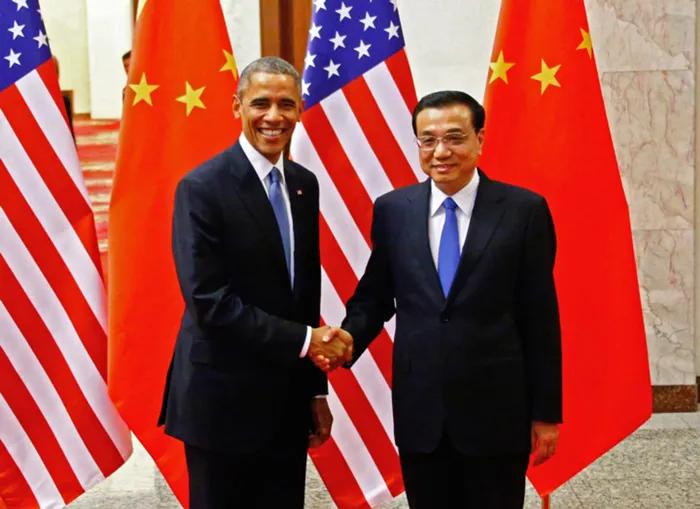
US President Barack Obama with China's Premier Li Keqiang during a meeting at the Great Hall of the People in Beijing, China, last week. Obama is in China to attend the Asia-Pacific Economic Co-operation 2014 Summit and related meetings. US President Barack Obama with China's Premier Li Keqiang during a meeting at the Great Hall of the People in Beijing, China, last week. Obama is in China to attend the Asia-Pacific Economic Co-operation 2014 Summit and related meetings.
The 22nd Asia-Pacific Economic Co-operation (Apec) meeting of economic leaders in Beijing last week brought with it renewed vocabulary in the international political architecture.
The “great power relations” depiction of the events led by Presidents Obama and Xi Jinping, dominated the news media and also offered a guide to a new model of bilateral relations.
With the end of the Cold War in 1989 and the collapse of the Soviet Union two years later, the US emerged as the most powerful state on the planet. Many commentators said we were living in a unipolar world for the first time in history, which is another way of saying America was the only great power in the international system.
The rise of China appears to have changed this situation. The Chinese economy’s continued growth at a brisk clip meant that the US once again faced a potential peer competitor, and great-power politics returned in full force.
Conflict
After a February 2012 visit to Washington, Xi championed his vision of a “new type of great-power relations” between China and the US. The Obama administration, in an apparent desire to avoid conflict with a rising China, seemed to have warmed to Xi’s articulation. In a major speech last November, US National Security Adviser Susan Rice called on both sides to “operationalise” the concept. And during a March summit this year with Xi, Obama declared his commitment to “continuing to strengthen and build a new model of relations”.
Some opinion makers have argued that with the US’s uncritical singing along the “new type of great-power relations” rhetoric, the Obama administration fell into a trap. However, some US officials dismissed this rhetoric as insignificant and saw it as harmless.
What is clear in the debates around this relationship is that the phrasing grants China great-power status without placing any conditions on its behaviour – behaviour that has unnerved US security allies and partners in the Asia-Pacific. At worst, the formulation risks setting US-Chinese relations on a dangerous course: implicitly committing Washington to unilateral concessions that are anathema to vital and bipartisan US foreign policy values.
Lest we forget, the November Apec summit follows on the heels of a US-Africa leaders’ summit held in Washington. This summit was conjectured as “to boost economic relations with Africa”. It is during this summit that some asked the question: what about China?
Those who asked the question were informed by the reality that since 2000, US trade relations with Africa have been dictated by the Africa Growth and Opportunity Act. As a unilateral preference scheme of the US to promote trade and investment in Africa, the act was meant to boost US trade with Africa and the development of the continent.
However, 14 years later, US trade in goods with Africa had demonstrated a perplexing downward trend since 2011.
US-Africa trade dwindled from $125 billion in 2011 to $99bn in 2012 and $85bn last year. For the first five months of this year, US-Africa trade in goods totalled about $31bn. At this rate, the total trade volume this year was forecasted to be well below $80bn in a continuation of the declining trend.
Contrast this with Chinese business with Africa, which has been growing exponentially. China surpassed the US as Africa’s largest trading partner in 2009. China-Africa trade reached $166bn (http://finance.chinanews.com/cj/2012/07-17/4037825.shtml) in 2011, an 83 percent rise from 2009. The bilateral trade increased another 19.3 percent to $198bn in 2012, and passed the $200bn threshold to $210bn last year.
In terms of trade volume, Chinese trade with Africa not only dwarfs US trade with Africa, but the gap is as large as 2.5 times the magnitude of last year.
The rhetoric and realities of American and Chinese trade with Africa present an interesting contrast.
Despite the callings in the US to boost economic relations with Africa and to “compete” with the expanding Chinese economic influence on the continent, the results seem less than impressive.
Many argue that the US’s soft power influence in Africa far outshines China’s. Thus, China also wants to win the hearts of Africans: Beijing would like to see more non-Western government engagement in Africa to mitigate its isolation in the international community and demonstrate that Western democratic ideals are not universal.
The stark question of the moment is: how do we (as Africans) effectively and efficiently benefit from the “great power” competition between the US and China?
Importantly, many would be tempted to discourage the US-China co-operation on the continent. They believe a lack of co-ordination creates an advantage for Africa because it creates checks and balances between the two powers, making room for Africans to maximise their flexibility. Unfortunately, this belief is grounded in the contradiction of a “good-hearted robber”.
Despite our wish for a healthy competition, there are great opportunities for Africa in Chinese-Western co-operation in African countries, particularly in the area of peace and security operations.
At the moment we lack an integrated approach and outlook in these matters which may prove detrimental to the benefits that seem to be in existence.
In fact, we may need to consider China’s domestic experience with foreign direct investment, and how China places high requirements for foreign companies to transfer their technologies as well as strict limitations on visas for foreign workers at joint ventures in China, forcing non-Chinese companies to train and invest in local employees. The idea of being able to climb the ladder of economic development is hugely attractive to local employees, and Africa-focused investments could gain ground by following this model.
I would still err on the side of those who argue thus: if African countries can prioritise and be clearer in their demands in engagement with these powers, Africa can exploit the different comparative advantages of the US and China.
* Maxon is a government communications official and a social commentator.