

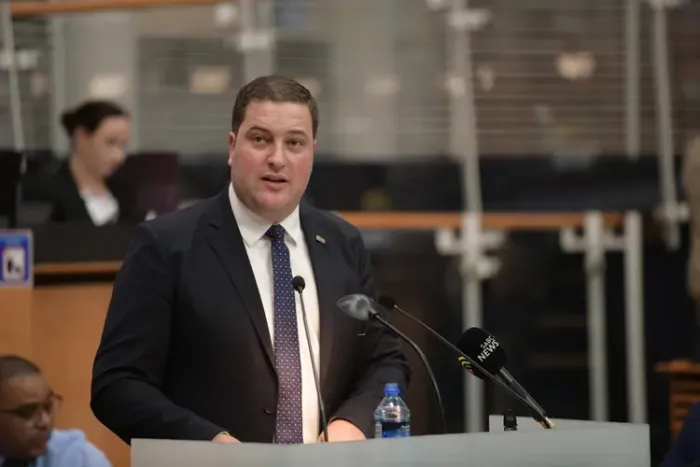
Cape Town mayor Geordin-Hill Lewis explained that they received 15,210 comments through both the March and May public participation processes related to the tariffs.
Image: Supplied
The City of Cape Town has defended its amended Hope Budget for 2025/26 following legal action from the South African Property Owners Association (SAPOA), which criticises the City's decision to link certain fixed charges to property values. SAPOA is now challenging the budget in court.
In their court documents, SAPOA CEO Nilesh “Neil” Gopal said they are seeking to challenge three items in the Budget, namely the Cleaning Tariff, the Fixed Water Charge, and the Fixed Sanitation Charge.
They are hoping to have the budget declared unconstitutional and invalid.
SAPOA’s membership currently comprises more than 90% of the country’s commercial and retail property industry, including some of the largest property-owning companies in South Africa.
The City of Cape Town filed its answering affidavit where Mayor Geordin Hill-Lewis explained that “in substance this application questions the role of the City in the determination of a budget at all and whether the City, or any other municipality, can indeed forge ahead on any new or innovative path to ensure not only better service delivery for all now, but also in the future”.
He said the City is aware of the relentless increases residents face in administered costs, electricity costs, municipal bills, food, fuel and household necessities, but that this has been “taken into account by the City at each step of the budget process”.
The mayor explained that they received 15,210 comments through both the March and May public participation processes related to the tariffs.
“Residents and organisations opposed the overall increases in rates and tariffs.
Hill-Lewis, in his affidavit, said that the City did not lightly decide to impose the three fixed tariffs which are the centre of SAPOA’s litigation.
“Neither does the City have ready alternatives simply there for the plucking, to replace the budgetary shortfall that will ensue should they be set aside. This shortfall will be an amount of R4,233,768,467 if all three fixed tariffs are set aside.
He also explained that property value bands differ from the “cent amount in the Rand” (being the basis of calculating property rates) as contemplated in the Rates Act.
“Property value bands are not applied or utilised under the Rates Act. The only commonality is that the Municipal Valuation Rolls used by both: (1) for property rates, the Rate-in-Rand (RiR) is applied to the municipal property valuation to compute the property rates payable; whereas (2) the property value band into which a particular property falls is determined by reference to its municipal property valuation.
He said that Cape Town's fixed charge serves as a deliberate and rational design intended to secure the revenue necessary to maintain and upgrade infrastructure, improve resilience and ensure reliable service delivery in the face of increasing climate-related uncertainty.
The matter is expected to be heard in the Western Cape High Court in September.
The Cape Independence Party (CAPEXIT) has meanwhile hit back at to the mayor’s assertion of a R4.2bn shortfall.
CAPEXIT Party leader and councillor, Jack Miller, said: “The DA is an absolute failure and an embarrassment to the people of the Cape."
Cape Argus