


Just over one in ten low-skilled workers left employment during 2024.
Image: Pixabay
More South Africans are moving between jobs, unemployment, and economic inactivity than they did five years ago, according to Statistics South Africa, pointing to a labour market that is becoming less settled.
Statistics South Africa’s Quarterly Labour Force Survey shows that 91.8% of people who were employed in the third quarter of 2024 were still employed in the fourth quarter. In 2019, the figure was 94.0%.
While the decline is small, it shows that fewer people are staying in the same job status from one quarter to the next.
A similar pattern is seen among people who were not economically active.
In 2024, just under nine out of ten people who were not working and not looking for work remained in that position three months later, down slightly from 2019. This suggests that more people either started looking for work or found jobs.
Among unemployed people, fewer stayed unemployed from one quarter to the next. In 2024, just under three-quarters of unemployed people were still unemployed three months later, compared with slightly more in 2019.
This means more people moved out of unemployment, either by finding work or by leaving the labour force, Statistics South Africa's data shows. Or, it is possible that they died or left the country.
The Quarterly Labour Force Survey tracks the same people over time, making it possible to see how individuals move between employment, unemployment, and economic inactivity.
This helps policymakers understand where support is needed, particularly for young people trying to enter the labour market.
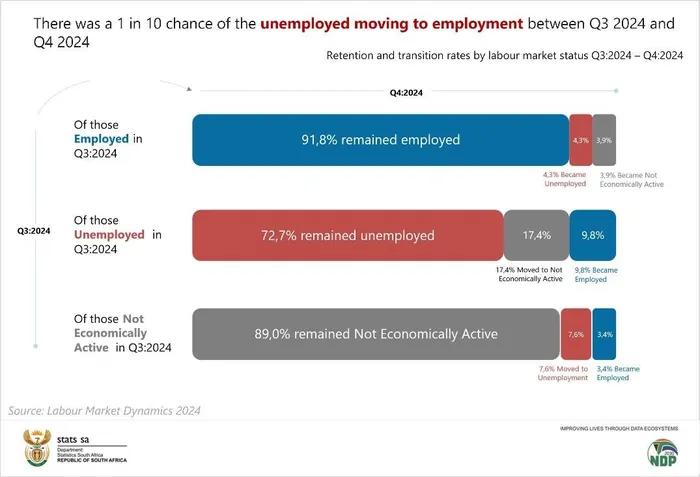
Statistics South Africa data shows movements between employment categories.
Image: Statistics South Africa
Work experience and education remain crucial. In 2024, nearly one in ten people with previous work experience moved into employment, compared with around one in forty among those without experience.
People with tertiary qualifications were more likely to find work than those without matric, Statistics South Africa reports.
Age and gender differences were also clear. Just over one in twenty young people moved into employment, compared with around one in fourteen adults. Women were also less likely than men to find work over the period.
Where people live matters too. The Western Cape recorded the strongest job stability, with almost nineteen out of twenty employed people staying in work between quarters.
The Free State recorded the weakest stability. North West had the lowest share of people moving into employment.
Job security was closely linked to the type of contract. People on permanent contracts were far more likely to remain employed than those on limited or unspecified contracts. Workers on unspecified contracts were the most likely to move into self-employment.
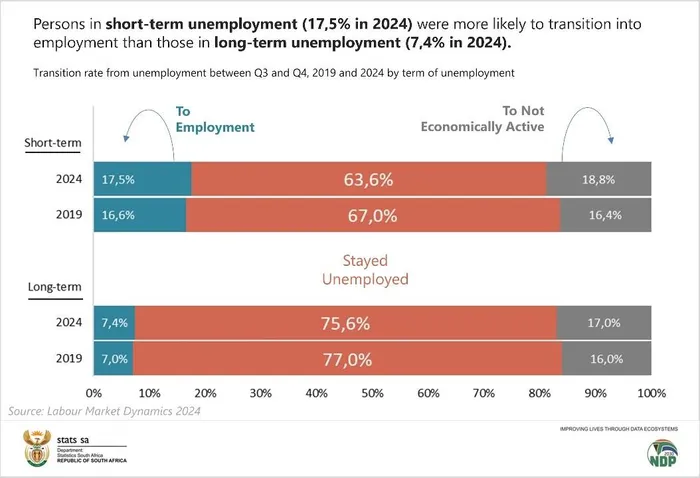
Statistics South Africa's data shows movement from part-time to full-time job status.
Image: Statistics South Africa
Skills and industry also shaped outcomes.
Just over one in ten low-skilled workers left employment during 2024, compared with fewer among semi-skilled workers and only a small share of skilled workers.
People working in primary sector industries were more likely to leave their jobs than those in other sectors.
The length of time someone is unemployed also matters.
Nearly one in five people who had been unemployed for a short time moved into employment in 2024, compared with fewer than one in ten among the long-term unemployed.
Overall, Statistics South Africa’s data shows a labour market in motion.
While most people remain in the same employment category from one quarter to the next, a growing movement highlights the importance of education, work experience, and job quality in helping South Africans secure stable employment.
IOL BUSINESS