

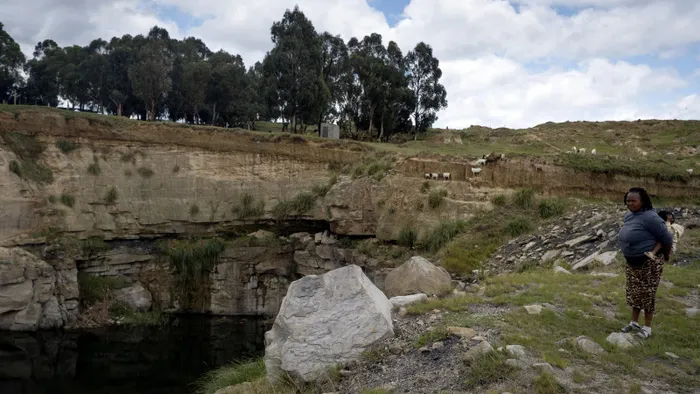
Communities living near abandoned and unrehabilitated mines often carry the consequences long after mining companies had left.
Image: Centre for Environmental Rights
Children have died in contaminated open pits at abandoned coal mines in Mpumalanga as South Africa’s mine closure crisis deepens, a new Centre for Environmental Rights report alleges.
The report warns that thousands of derelict mines continue to leave communities exposed to environmental, economic and health risks years after mining operations stop.
"Dangerous, contaminated open pits at the abandoned Imbabala site have led to the deaths of children," report author Tarisai Mugunyani stated.
Human Rights Watch (HRW), in its 2022 report The Forever Mines: Perpetual Rights Risks from Unrehabilitated Coal Mines in South Africa, documented these deaths in what it described as a turning point for two families in Ermelo.
“On 24 September, 2016, everything changed for two families in Ermelo, a town in Mpumalanga province, eastern South Africa, in the heart of South Africa’s coal country.”
This, the organisation said, was the day 17-year-old Xolani Mthembu and his 14-year-old friend, Sifiso Yende, drowned in an abandoned coal mine in Wesselton on the northern outskirts of Ermelo.
Following the drownings, an official from the Msukaligwa Local Municipality promised that the government would ensure access was restricted and erect warning signs at the mine site, HRW said.
"Five years later, when Human Rights Watch went to visit, the site was still completely accessible with no fence, restrictions on access, or warning signs," HRW alleged.
The Centre for Environmental Rights said the abandoned mine near Wesselton in Ermelo had continued posing risks to nearby residents more than a decade after operations ceased. "The site continue[s] to pose serious risks to residents," the report said.
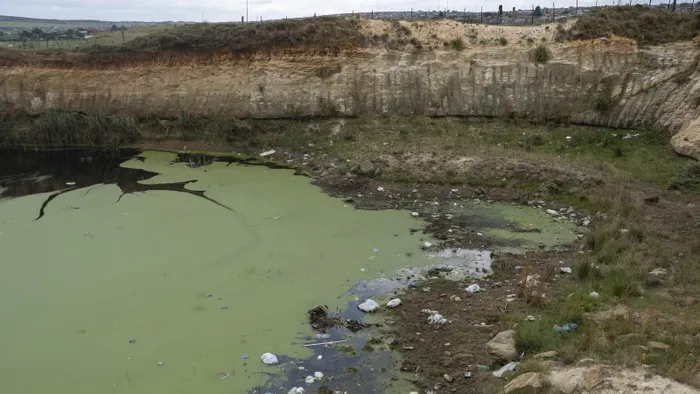
Dangerous contaminated open pits at the abandoned Imbabala site have led to the deaths of children.
Image: Centre for Environmental Rights
Imbabala is an abandoned coal mine located in Ermelo, Mpumalanga. Previously owned by Imbabala Coal, the company abandoned operations in 2011 after the then Department of Mineral Resources and Energy (DMRE) ordered mining activities to cease because the company was operating without a water-use licence.
The DMRE has since transitioned to become the Department of Mineral and Petroleum Resources (DMPR).
Despite the mine having been abandoned since 2011, "neither the company nor the government has taken visible steps to properly close or rehabilitate the site," Mugunyani stated.
The report, titled No More Ghost Towns: Lessons from Mpumalanga's Mine Closure Crisis, was produced by the Centre for Environmental Rights and examined the state of mine rehabilitation and financial provision in South Africa's coal mining heartland.
South Africa currently had "an estimated 6,100 abandoned and derelict mines", including "at least 400 abandoned coal mines", the report said.
Rehabilitation "rarely takes place during mining operations or after closure, particularly in the coal sector," Mugunyani wrote.
An Auditor-General South Africa (AG-SA) audit in 2021/22 referenced in the report found that, of these 6,100 derelict and ownerless mines, 2,568 were high-risk and there were 1,170 dangerous openings, while only 555 mines had been rehabilitated.
The DMPR's 2025 annual report said the department closed 280 hazardous mine openings and rehabilitated derelict sites, while intensifying action against illegal mining.
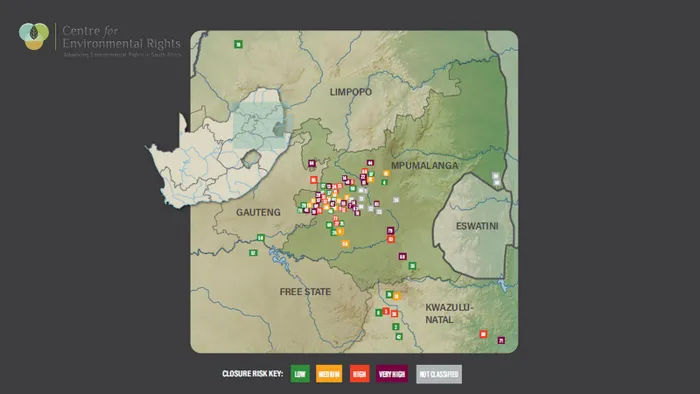
Mines at risk of closure across South Africa.
Image: Centre for Environmental Rights
However, its actual achievement, as contained on page 80 of the report, showed it only rehabilitated four "derelict and ownerless mine sites" – an increase of one against its plan, but only because two previously targeted mines were carried over from the prior year.
In the Auditor-General's report on the DMPR's finances, it said the department's planned target for rehabilitation was "not achieved”.
In Mpumalanga specifically, "fewer than six closure certificates were issued for mines in the province between 2011 and 2016, none of them for coal," the Centre for Environmental Rights said.
Minister of Mineral and Petroleum Resources Gwede Mantashe's 2026/27 Budget Vote stated that R23.48 million was allocated for the Mine Rehabilitation Research Project and R140.87 million for the rehabilitation of derelict and ownerless mines.
Communities living near abandoned and unrehabilitated mines often carried the consequences long after mining companies had left. The report said communities faced "water and soil contamination, loss of arable land, and serious health consequences."
Environmental damage frequently continued "long after mining operations have ceased" and many communities remained trapped with "the long-term legacy of mining and insufficient government action," the report said.
Communities living near mines were often "economically vulnerable and lack the resources needed to participate effectively" in mine closure processes. The report said the law "does not clearly prescribe how these consultations should take place", while consultation practices "vary widely between mining companies."
Mugunyani also linked poorly managed mine closures to wider socioeconomic decline in mining communities. "When mining operations cease without adequate transition planning, communities frequently experience rising unemployment and related social pressures, including declining morale, increased crime, and economic instability," the report said.
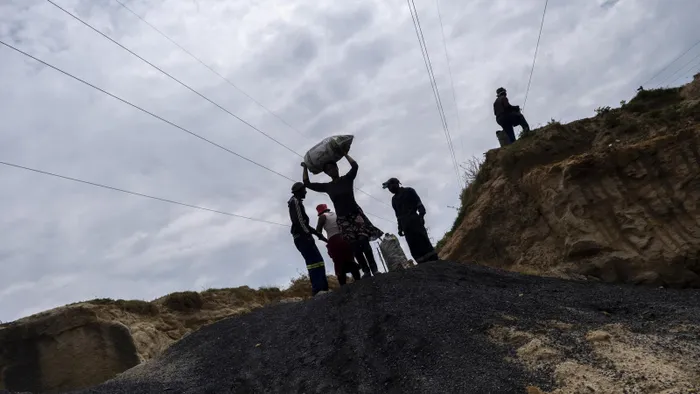
South Africa currently had "an estimated 6,100 abandoned and derelict mines" that illegal miners can take advantage of.
Image: Centre for Environmental Rights
Abandoned mines had become sites of illegal mining activity, "posing serious safety risks," Mugunyani stated. Informal miners "may become trapped or killed underground," the report added, with such incidents contributing to "broader social instability."
In the Free State, the DMPR said that "although illegal mining is still experienced in the region, it has been reduced drastically due to the rehabilitation and closing of old underground holes with rubble.”
Under South African law, mining companies were required to make financial provision for rehabilitation before mining operations began, to ensure sufficient funds or financial guarantees were available to rehabilitate environmental damage, seal dangerous openings and manage pollution once mining activities ended.
However, mining companies typically secured these obligations through mechanisms such as rehabilitation trusts, bank guarantees or insurance guarantees rather than paying cash directly to government upfront.
The report argues this creates risks where guarantees prove insufficient or insurers backing rehabilitation obligations collapse
The Centre for Environmental Rights report specifically warned that South Africa relied "almost exclusively on bank and insurance guarantees rather than ring-fenced cash or trust funds", which it said created "significant risks that rehabilitation costs will ultimately be borne by the public."
The report cited the liquidation of Constantia Insurance in 2022, which had issued approximately R45.5 million in guarantees linked to Mpumalanga mines, warning that there was "no clear mechanism to recover funds" after the collapse.
All active policies were cancelled with a 31-day notice period ending in late 2022, and policyholders with unpaid claims became concurrent creditors of the liquidated estate — meaning they joined the queue with other creditors for compensation, with no guarantee of recovery.
Between 2000 and 2023, companies in Mpumalanga held R14 billion in financial provisions, the Centre for Environmental Rights found.
Mugunyani warned that many older mines nearing closure continued operating under "earlier and weaker financial provision requirements", increasing the likelihood that the state "will ultimately bear the costs of rehabilitation using limited public resources".
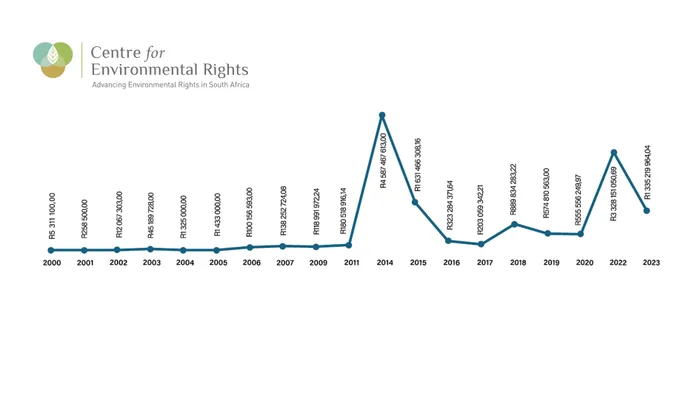
Financial provisions made for mine closures.
Image: Centre for Environmental Rights
The report placed the mine closure crisis within the broader context of South Africa's coal dependence and climate pressures.
Coal combustion "accounts for more than 30% of global greenhouse gas emissions" and South Africa was described as "one of Africa's largest emitters and ranks among the top forty globally."
The country faced growing pressure around the Just Energy Transition and the "anticipated phase-out of coal." Despite the scale of the challenge, progress on rehabilitation remained slow, the report said.
The report also raised concerns about transparency and access to information in the mining sector. "Access to information remains a serious and systemic challenge," it said.
IOL BUSINESS