

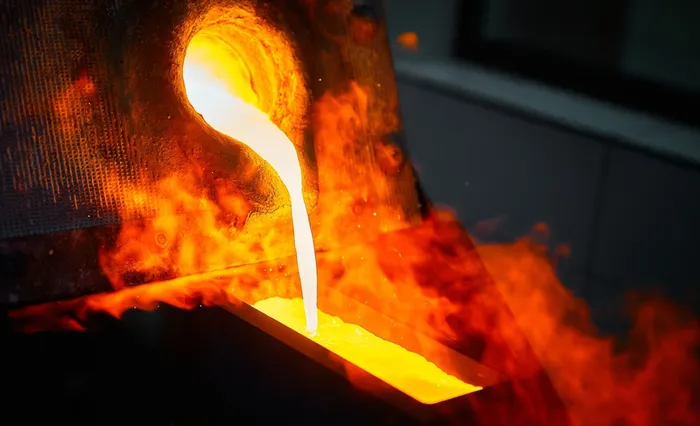
A pour of gold at Pan African Resources’ Mogale Tailings Retreatment plant - rising metal commodity prices and likely to provide a windfall for the government's tax collections.
Image: Supplied
Booming gold and other high commodity prices will provide a big boost to South Africa's tax collections, with the benefits likely to begin filtering through the fiscus in the second half of this year, while also growing the mining sector, Minerals Council South Africa President Paul Dunne said on Monday.
He predicted at the Mining Indaba in Cape Town on Monday that current high metals prices were "not a flash in the pan," - metal commodity price cycles are notoriously volatile - and this "not unsubstantial tax windfall" is likely to provide a welcome relief for the government, which has been hard pressed to find additional tax income in recent years.
Mineral and Petroleum Resources Minister Gwede Mantashe said meanwhile that the government has developed a Critical Minerals Strategy, and implementation is now underway. The definition of critical minerals has become crucial because the global energy transition, and changing industrial requirements, has resulted in shifting demand for certain mined commodities, some of which will likely be in short supply in the future.
Mantashe said the definition of "critical minerals" means different things in other places, such as in the US it is defined as those necessary for military purposes, in China it is minerals required for technology development, while in Europe, critical metals are those necessary for environment changes.
"Here (in Africa) we need a range of critical minerals. One of our critical minerals is coal, it employs people, generates export earnings and is required for base load electricity and other purposes," said Mantashe. If one considers Africa's development needs, steel is as critical a mineral as copper is to the global energy transition.
He said if South Africa, for instance, discovers additional copper resources in the Northern Cape, it should be the responsibility of the government to "compare notes" with Zambia, which also mines copper, so that the two countries can work together to beneficiate the metal, and to see that parties don't play the one country off against the other in terms of policies and prices.
He said African countries need to harmonise their regulatory frameworks. "It's a long way to go, let's give it a go," he said
"African countries must not give away their leadership or their roles and be at the mercy of one party or another in the allocation of their resources," he said.
Minerals Council South Africa CEO Mzila Mthenjane said along with high prices for many commodities, the South African mining industry had also benefited from improvements in rail and logistics, with for instance, coal export volumes rising to 57.9 million tons by November 2023, compared with 48.7 mt in 2022. In addition, iron ore exports were likely to stabilise at around 52 million tons in the next two years.
The higher commodity prices, more stable production and increased commodity demand has also resulted in the sector creating 2000 more jobs in the third quarter of 2023, to about 474,000 jobs.
On the electricity front, the sector had benefited from no more loadshedding, but there remained concern about structural reform in the electricity sector, because, for instance, Eskom now planned to keep its transmission unit as a subsidiary company, while originally the plan was for it to operate as an independent unit.
In addition, electricity prices continued to rise - it had increased by more than 970% since 2007, while in comparison, inflation had only increased by 155%. The council said further increases were already in the pipeline, with an 8% rise electricity tariffs scheduled this year and another 8% next year, both of which were well above inflation.
Mthenjane said the government needed to seriously consider additional incentives for mining companies to take on the additional risk of exploration, because mining exploration expenditure was only R781 million in 2023 from a peak of R6.2 billion in 2006 - globally, exploration expenditure tends to increase when commodity prices rise.
Mantashe appealed to private companies to contribute to the government's Junior Mining Exploration Fund (JMEF), as "mining will die if there is no exploration."
He said the government had removed the black economic empowerment requirements for mining exploration companies, because exploration made no direct contribution to the economy.
"This is not a retreat from transformation, nor is it an endorsement of the misguided view that black participation is a barrier to economic growth. It is rather a pragmatic recognition that prospecting is a high-risk phase where no economic value has yet been proven," he said.
He said the second round of the JMEF was now underway with 80 applications received targeting tin, tungsten, titanium, uranium, gold, antimony, arsenic, fluorspar, copper, and lithium. Four projects funded by the JMEF were ready for mining, he said.
Visit:www.businessreport.co.za