

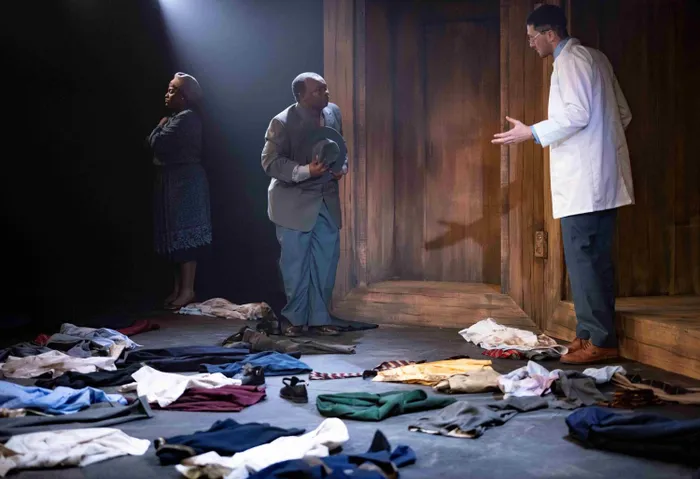
Mfuneli Ntumbuka, Sbuja Dywili and Ben Albertyn.
Image: Fiona MacPherson
Experience a powerful retelling of a pivotal moment in South African history with 'Rise ’76', a poignant play that explores the legacy of the June 16th tragedy at the Baxter.
This is the final week that you can catch it (ends on Saturday, 30 May), before it transfers to The Market Theatre in Johannesburg.
This year marks 50 years since the tragedy, when hundreds of school children were killed in Soweto, and the photo of a deceased Hector Pieterson carried in the arms of Mbuyisa Makhubo with Hector’s sister Antoinette Sithole beside him shocked the world. Hector was 12.
The production, directed by Tiisetso Mashifane wa Noni, vividly captures the volatile environment between the Department of Bantu Education, the South African police, and a generation of school learners pushed to the brink of despair.
Photographer Sam Nzima took the photo, and his testimony is among those brought to life in this play. Stories of parents who lost their children, some as young as four years old, are presented too.
The play mentions anti-apartheid icon Winnie Madikizela-Mandela as having dropped some of the murdered children off at a Soweto hospital.
On stage, doctors talk about hundreds of bodies and bullet wounds. In the hospital, the audience is invited to imagine what a mother told a doctor when she went looking for her murdered child.
Tiisetso Mashifane wa Noni, who wrote and directed this play, said she interviewed 40 people and dug into archives to articulate this story.
“With an event of this magnitude, thousands of details can easily fall through the cracks. So, with this play, I’ve only picked up what I think are only a couple of crumbs,” she said.
“To explore this, the play adopts a documentary style storytelling lens that zooms into the lesser-explored domestic moments — like listening in on a teaching staff meeting as they discover all the textbooks are in Afrikaans, catching a glimpse into a secret student logistics meeting or witnessing someone getting arrested before they could even take their morning bath.”
While this is a well-known story, the script avoids any stereotypical traps. The characters are believable as the actors do not overplay any tears and their pauses come off at the right time.