

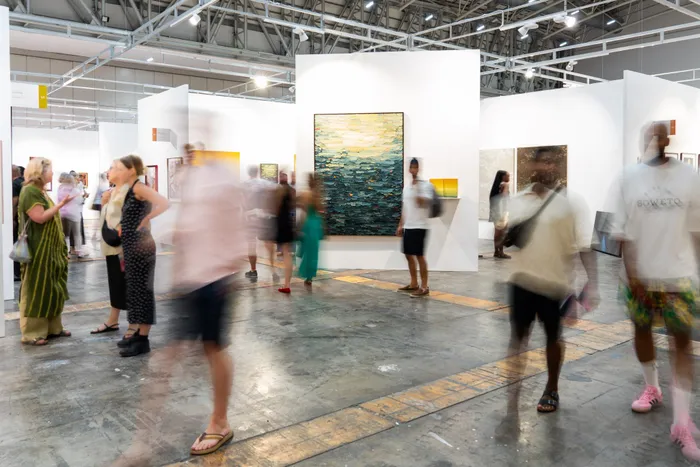
Images by Rachel, founder of SAIA NOIR Photography, an international photographer from Amsterdam, The Netherlands. Documenting Cape Town Art Week
Image: .
"I don’t give a f*** if it’s sold! Why is it still on the wall? I want it!" shrieked an elderly woman at a Bode Gallery assistant who looked like she was dissolving. The problem was a Mhlonishwa Zulu; an entirely emerging, entirely sold out, artist's work. I 'swear' I am not making this up. I was innocently eyeing a Yonela Doda pinned teddy bear on Bode's desk. Tempers just ignited behind me. The gallery quietly decided to pull down most of their sold works off before things got messier. This sort of behaviour is textbook art fair stuff, I am told.
Sunday was the last day of the Investec Cape Town Art Fair. It started on Friday, 20 February, at the Cape Town International Convention Centre (CTICC), and I can safely say it was one hell of a big, roaring trade show.
This was the first time I actually observed the business of the art fair in action. All these years I had paid attention to the art, never the very present card machines on every booth.
At some point, I witnessed $100 notes being dolled out over what I thought was a rather dull artwork. Out of respect for the artist, I will not mention which one. Some buyers requested that works be taken down immediately after purchase. Others requested shipping after the fair. Which is fair, for us to also see it.
I witnessed an Italian man having a meltdown at a booth that had practically sold out all of its paintings. "Is there anything you can do?" he asked sadly, near teary, to which the assistant replied along the lines of, "We do not want to put pressure on our artists, but we will put in a request for you."
It was mad business. Suddenly it dawned on me why anyone would pay hundreds of thousands to secure a booth at this fair. You will sell!
"It was our first time here. The Art Fair rejected our application in 2024. But we tried again last year, and they approved. So far it is going very well," said a Uganda-based Umoja Art Gallery assistant. Nails marked where artworks had been. Only a few Pamela Enyonu works remained, priced at $5000 each, with over 20 pieces sold in just three days. Do the math.
At the Suburbia Contemporary booth, Ed Young was unusually jovial. "Someone bought my piano!" We stared at the self-playing piano, cut down to one-third of its size. "Look, this piano actually won last year’s Helgaard Steyn Prize for Sculpture!" It is titled Other People’s Tears Are Just Water and it even allows fair visitor to see the inner workings of the piano.
One day I will buy myself a Jake Aikman painting.
One day I will buy myself a Ben Stanwix and Xhanti Zwelendaba fabric artwork from RESERVOIR Gallery.
One day I will buy myself a Rosie Mudge painting from stellenboschmodernartcontemporary (SMAC).
One day I will buy myself a Kirsten Sims painting from 131 A Gallery. She sold out. At R130 000 per painting.
One day I will buy a Roméo Mivekannin painting from Galerie Éric Dupont.
One day I will buy a Hedwig Barry painting from Graham Contemporary.
One day I will buy my daughter a Pichulik handbag (before it reaches Vuitton prices) at the Capsule section of the Cape Town Art Fair.
One day. Once said Brett Murray.
Have you observed the pattern in my wishlist? Paintings.
That’s the thing about this year’s Investec Cape Town Art Fair. Themed Listen. They got it right this time.
Even Blank Projects behaved and came to the party with Annabelle Agbo Godeau paintings, Jared Ginsberg paintings, Donna Kukamma paintings and Gregory Olympio paintings. Of course they had Kyle Morland and James Webb sculptures. Blank delivered. Stevenson delivered. Goodman delivered. Christopher Moller delivered. They all delivered.
There was far less abstraction and experimentation this year. Sanity has finally made its way back to the artworld.
The performance art features were also a welcome addition this year. I even bumped into Steven Cohen in drag, preparing to perform Taste, which explores the body and identity.
Hannalie Taute’s piece, I’M FINE, was moving.
Gabrielle Kruger did a live performance painting.
Oupa Sibeko staged a ritual/play-based performance.
Lux & Kahlil presented Eavesdrop, an ongoing listening-and-reflection project.
Mucking Afazing! As some bakery I like would say.
"Last year we welcomed over 30,000 visitors. This year, we’ve listened closely to how people want to experience the fair. The 2026 programme is designed to reward return visits, offering different points of entry each day. Whether through a walk, a workshop or a conversation. It’s about creating a space where curiosity is encouraged and discovery is ongoing," said the fair's director, Laura Vincenti.
Still, on the business of selling. Even the City of Cape Town's Community, Arts and Culture Development Department’s Emerging Artist Programme (EAP) booth was booming. Ricardo Nieuwoudt sold just over 50 of his miniature paintings. Priced at R500 each. Juan-Ridge Isaacs's technical illustrations were also something to behold. If he could just make them much much bigger. Lona Ndzimande's portraits gazed back well, attracted eyeballs and gave off Jody Paulsen / Athi Patra Ruga / Blessing Ngobeni all-in-one vibes. These young artists are no longer "emerging" artists.
On sculpture: I already mentioned Ed Young’s piano.
I did not mention Mary Sibande at Everard. Mary Sibande stole the show with her rotating, life-size Sophie avatar. A dear former CFO of a listed company described Sibande’s work as “transfixing!”
I did not mention Ledelle Moe, who sold a tiny bird-shaped stone for R8000 at SMAC. A stone!
I did not mention Mandy Johnston’s wooden human sculpture at Berman Contemporary. Hauntingly beautiful burnt wood with a beeswax seal. It had an anorexic Jackson Hlongwane sculpture aesthetic.
I did not mention the dedicated spotlight cast on Edoardo Villa’s work. He of the large red The Knot sculpture outside the Cape Town Civic Centre. The most prolific sculptor in Johannesburg, with literally 1200+ sculptures out there.
"The brilliance of Villa is the quality of the engagement he affords us. There is nothing passive about a Villa sculpture. It is commanding, demanding, obscure, radical and highly passionate. And that is the language of South Africa," Ashraf Jamal said at a closing talk session on Sunday.
“Edoardo Villa was always available. He was a hard worker. He worked every day, 8 to 4. Sculpture was a job for him. Walk into his studio any time and you would find more than 40 sculptures ready. He made himself known in art. He was prolific with academic institutions. A small man in stature, but he knew everyone and remembered everyone’s names!” said a panelist whose name I forgot. Sorry.
To see more Edoardo Villa sculptures, don’t go to Johannesburg. Head to the newly opened BlackBrick Hotel in Gardens, Cape Town. That hotel is hosting a temporary exhibition titled Exploded View: Edoardo Villa & 21st-Century Sculpture, running until 19 May 2026. Good luck navigating that extremely brutalist architecture hotel with its staggered senseless stairs. The artworks on show inside will blow you away though if you’re into abstraction and conceptual sculpture. Think Kamyar Bineshtarigh. Think Gaelen Pinnock. Think Alexander Opper. And more. If you’re a traditionalist, like a Cape Town artist named Mrs Blacker (I forgot her first name), the entire show might just be “Rubbish!” She asked me “Is this art now? Where is the art? Where is the beauty? Where is the form?”
Back to the 13th edition of the Investec Cape Town Art Fair. It is always hard to retro-write about fairs because I want to be fair to everyone there. But given the scale; 126 exhibitors from 34 cities, presenting 490 artists, I just can’t. I am sorry, Alexandra Karakashian, I wanted to write about your Southern Guild abstract monochromatic painting that was taken down early.
Art aesthete Nhlanhla Xaba described the entire fair experience as one requiring a scheduling assistant, runners and coordinators.
Ja. Nee. It was a lot. I did not even go into the after-parties and dinners. But the Our Own Hands | A Collectors’ Dinner, presented by Art School Africa and Magugu House at the Mount Nelson Hotel, was special. Intense conversations. Good food. Beautiful guests such as Basetsana and Romeo Kumalo, Trevyn and Julian McGowan, Gavin Rajah, Thebe Magugu, Zanele Muholi, Zanele Kumalo, Lulama Wolf, Anelisa Mangcu, Ugoma Ebilah, to name a few. I was honoured to attend. You have to see the Magugu House and Magugu Suite at the Nellie! It even includes selected works by Zizipho Poswa and Zanele Muholi downstairs.
Let me wrap up with a comment from Dr. Same Mdluli, curator at Standard Bank Galleries: "Art fairs, in Africa in particular, are important for invigorating the art ecosystem. This year's fair felt bolder and richer than the last. Not so much in quality but more importantly in content."
Cape Times