

And the Girls in Their Sunday Dresses is a timeless South African classic. It was first published, in print, in 1993 by Wits University Press.
Image: SUPPLIED
What I don’t usually mention (ever) is that, in 2002/3, I was enrolled for drama studies at UCT’s Hiddingh Campus. It didn’t last. The late Yvonne Banning regarded me as a talentless actor. She had a look that just said it. I know. I, on the other hand, found drama movement classes and breathing exercises oppressively boring. Lugubrious, even.
But. In that brief year or so, I met quite a handful of people who went on to become some of the finest contemporary actors, theatre-makers and producers today. In hindsight, leaving drama might have been a rash decision on my part.
Take for example Mdunyiswa “Mdu” Kweyama, who was in my class back then. Over the years, I’ve noticed his name attached to a number of productions such as The Goat, Who Is Sylvia? and Trouble in Mind.
I was pleasantly surprised to find his name at the helm of Zakes Mda’s two-hander, And the Girls in Their Sunday Dresses.
"I first read the play as a student and remember being very drawn to it. Over the years, many students have worked with extracts from the play in small group acting projects. When I spoke to Lara [Foot], the CEO at the Baxter Theatre, I mentioned that I wanted to stage a South African classic, and she supported the idea. We then approached Zakes Mda, who kindly granted us permission to stage the production," Kweyama told me, as we reminisced over our drama school days.
"I began conceptualising the show in late November last year and had my first meeting with the set designer around that time. We have had four weeks to put the production together with the two performers and the creative team."
And the Girls in Their Sunday Dresses is a timeless South African classic. It was first published, in print, in 1993 by Wits University Press.
Nothing worries me more like a bare stage; no curtains, no props or basic furniture even. For me it simply signals a certain austerity. What you are seeing is precisely what you are going to get. So, when I spotted that lone chair on stage, a familiar anxiety crept in. 80 minutes. One chair.
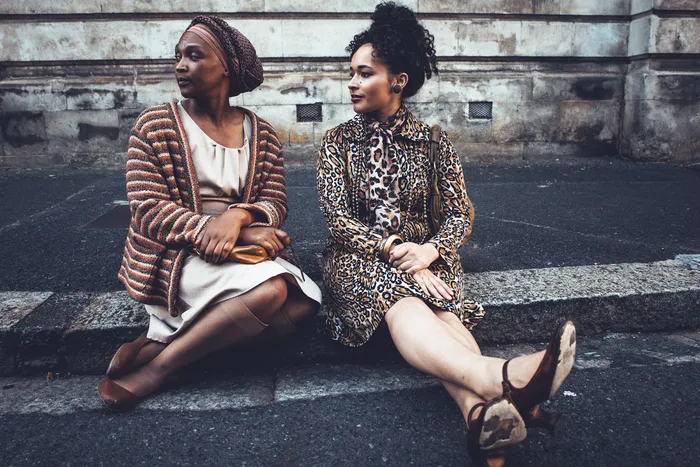
Yet my fears were allayed the second the two lead actors sauntered onstage. One buttoned-up, sensible shoes and had a maternal poise. The other looked like she’d just stepped out of a midnight confession booth, all heat and trouble. The contrast alone was enough to render my attention lights on? My plus-1 rolled their eyes when they saw me sit up for this part.
Awethu Hleli plays The Woman and Tamzin Daniels plays The Lady.
"The Baxter Theatre has a company called Fire’s Burning and the two performers are part of that company. When I re-read the script, they were the first people who came to mind for these roles. Even if they were not part of the company, I would still have chosen them for the production."
The set design I learnt was not bare because Lara Foot was pinching pennies. It was deliberate. It was a conscious nod to scarcity, the kind that sneaks into everyday life, shaping routines, desires and the very air we breathe.
Kweyama wanted towering walls and massive doors that dwarf the actors, forcing them to tilt their heads upward, like worshippers in a quiet, expectant prayer. A reflection of the deference society often demands.
The closed doors aren’t just architectural. They are a statement. A rigid divide between those granted access and those left outside, hungry, pacing, waiting for a chance that may never come.
Even my lonely chair, on stage, carried its own weight. For me it suddenly stood for poverty, the pinch of limited means, ukukhulela elokishini kwanokujamelana nekati eseyaqhela ukulala eziko. Intlupheko. Ubume bethu bemihla ngemihla kweli. Amatyotyombe. Amagumbi wangasese aphandle. Yonke nje lo nto. Oku uKweyama ukubhentsisa bhe eqongeni. Every element in this production whispers the everyday reality of scarcity and exclusion.
Shine nto kaKweyama, shine!
The story follows The Woman and The Lady whose lives intersect in unexpected ways, offering observations on relationships. While they wait in a queue, their stories unravel with satire and tenderness, exposing the inequalities, corruption and daily bureaucratic battles that shape their world.
That Kweyama pulled all of this off with so few resources and kept me riveted the entire time, is a testament to a director who has truly earned their stripes.
Every choice, every nuance, speaks of experience, vision and a command of the stage that doesn’t need flash to mesmerize.
The show is on at the Baxter Studio until Saturday, March 7. There are Saturday matinees at 3pm as well.
On Thursday, February 26, Zakes “Bra Zakes” Mda will be in the house to witness his play performed live. It was first staged way back in 1988, when I was 7, at the Edinburgh Fringe Festival. No, I was not there. It will be fascinating to see how Bra Zakes responds to this latest interpretation. Decades later. With new energy. New choices.
On Thursday, if tickets are still available would be the best night to even secure oneself a meet-and-greet with the author and director.
In all honesty though, I shouldn’t be saying “Bra Zakes.” It is Tat’ uMda now. The “Bra” days are long gone for this 77-year-old accomplished writer, painter and composer.
Tat’ uZakes Mda’s play has always laid bare how systems of power can compress human beings into nothing more than bodies shuffling in a line. And yet, he reveals the ways people push back. Through imagination, memory, humour and the sheer force of storytelling. The women’s voices, their interior worlds, their quiet resilience, resonate powerfully with contemporary South Africa, where inequality may have learned new words, but its weight remains unmistakable.
"I would like audiences to leave this production with a sense of resilience and a fighting spirit," concluded Kweyama.
Cape Times