
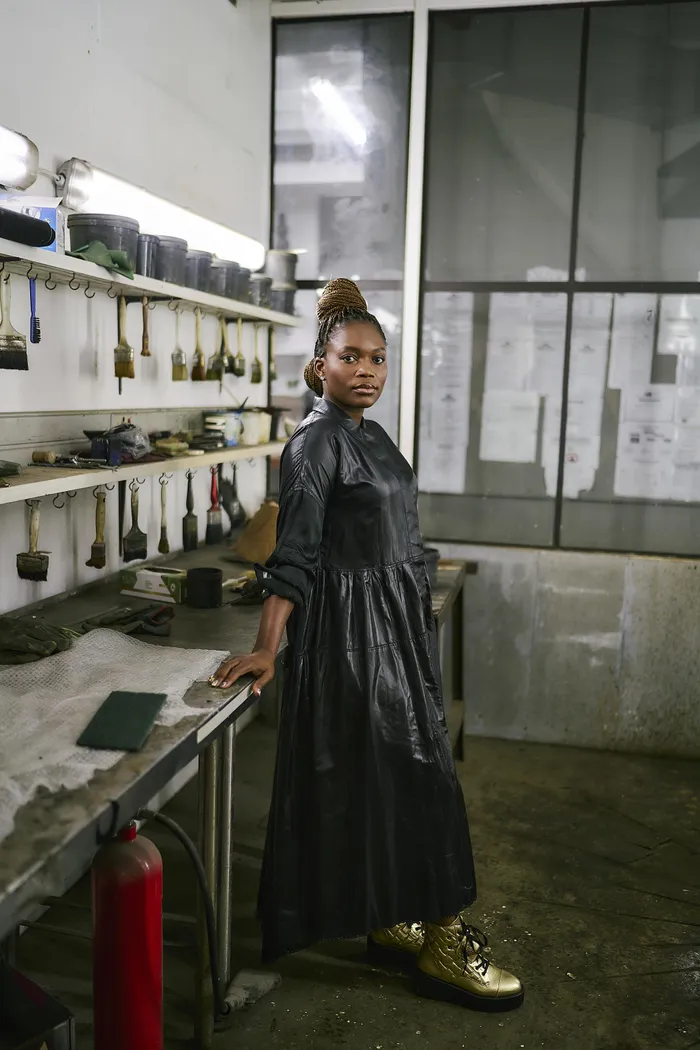
Zizipho Poswa.
Image: Supplied
The art world was once confronted with the discomfiting spectacle of an artist’s unmade bed presented as a work of art. It was in 1998, at the Saatchi Gallery in London, where Tracey Emin exhibited My Bed. It was a tableau of rumpled sheets and intimate detritus, suggestive of a young woman who had abandoned the idea of making her bed. Ever. Kwakuthengiswa ubuxelegu ngelithi ngumsebenzi wobugcisa.
I was reminded of this when I saw process-photos of Justine Mahoney’s bed positioned squarely in the middle of her warehouse studio at the Waterfront, where she was preparing her new solo exhibition, Pareidolia, now on at Southern Guild in the Silo District. She slept there. Literally. Night after night.
I’m told that her husband entertained thoughts of divorce during this time. One can imagine the strain. A spouse who does not come home, because of art. I am kidding. The husband seemed happy at the show.
“I loved being in that warehouse. It was a year of solid, hard work,” said Mahoney before we arrived at the subject of her return to painting, a medium she had set aside for years while dedicating herself to sculpture.
“I can’t quite place my style. I am simply exploring the possibilities of oil paint and turpentine. I paint intuitively. It’s almost anti-painting. I let the drips fall where they will, beneath the brushstrokes.”
I, too, struggled to pin down this style. Tracey Emin came back to mind again; like Mahoney, she rarely approaches a canvas knowing exactly what she intends to paint. Both share a certain carelessness with paint, a willingness to let intuition guide the work. So perhaps the best I can say to someone asking me about Mahoney's work is: It's minimalist Tracey Emin paintings, with far less colour.
Mahoney’s canvases are said to "dissolve the boundary between body and atmosphere, offering a porous meditation on entanglement and the stubborn refusal of singular form". She has a tedious way of working.
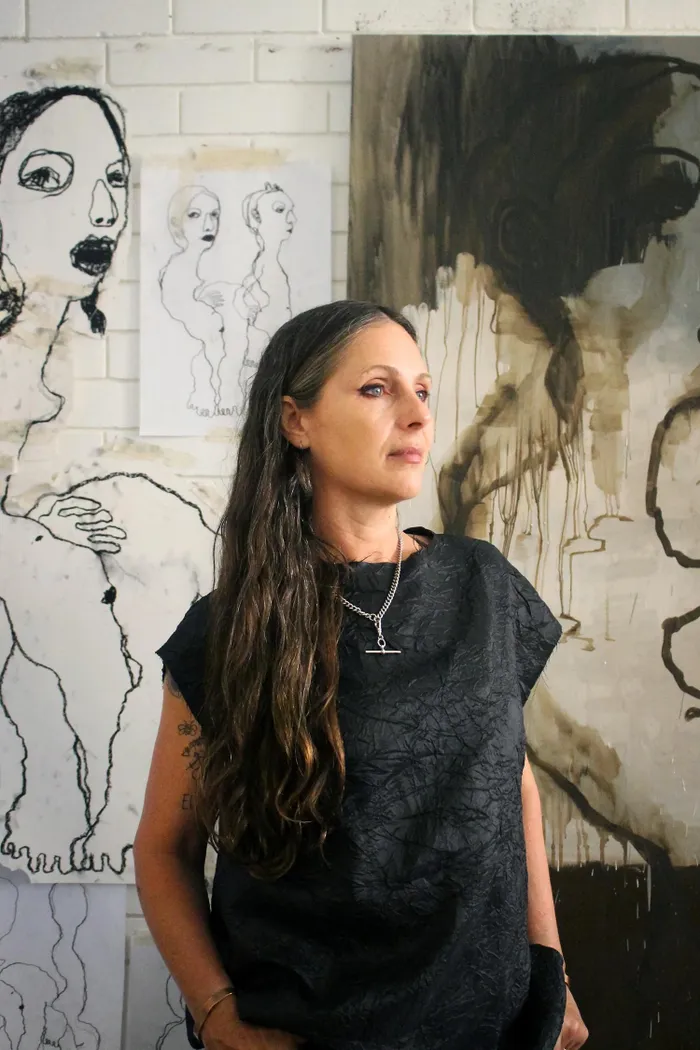
Justine Mahoney.
Image: Supplied
It starts with minimal charcoal drawings on paper.
Then tearing the charcoal figures on paper.
Then extending and reassembling them.
Then reconstructing them with masking tape.
Eventually human shapes emerge. She calls these imaginary bodies. Her fingerprints are embedded in the very DNA of the works long before the first application of turpentine and oil paint meet the surface. I initially mistook these paintings for watercolours. Her work just has this obscure beauty that lingers far longer than it should. I love it.
On the Thursday of the opening, way before the first guests arrived, Mahoney and Zizipho Poswa, whose solo exhibition occupies the adjacent main floor at Southern Guild too, performed a quiet ritual of spatial reclamation. Poswa burnt Impepho (sage), Mahoney burnt Palo Santo (Spanish holy wood). By the time the doors opened, the air was settled. Thus, I had nothing to complain about this time around.
And that’s the thing about Southern Guild lately, there seems to be a connecting thread of spirituality running through their artists.
"Many of Southern Guild’s artists are reclaiming ancestral knowledge, spirituality and material traditions as a way of understanding identity, memory and belonging. This isn’t something the gallery prescribes. It emerges organically from the artists’ practices. Our role is to support work that is authentic and rigorous, and that reflects the complexity of lived experience," said Trevyn McGowan who co-founded the gallery with her husband, Julian, in 2008 when there was growing international interest in contemporary art and design from the Global South.
Today it boasts two additional locations in Los Angeles and, as of 2026, New York. They are home to quite a number of prominent artists such as Nandipha Mntambo, Zanele Muholi, Rich Mnisi, Usha Seejarim, Xanthe Somers, Alexandra Karakashian, Andile Dyalvane and Kamyar Bineshtarigh, to name just a few.
But let’s go back to last week Thursday. Zizipho Poswa’s fifth solo exhibition, Imbeleko, at Southern Guild.
Ndisuke ndiswele amazwi; ndifune ukuqhabalaka ngesiXhosa sodwa. Ibhongo neqhayiya. La magama mabini ingasisishwankathelo sendlela endiziva ngayo ngalo msebenzi mtsha kaZizipho. Mhle. Kusetyenziwe. Hayi nje kancinci. Andisathethi ke ngeendwendwe ebezizimase lo msitho wokuvulwa kwalo mboniso. Ibibubumbejembeje bodwa. Ubungafunga uthi uzimase laa migidi kanokutsho xa uqwalasela izinxibo. Bonke bebezizikhakhamela neendwalutho kum ngala mini.
It is rare to see African traditional wear so vividly alive in the city, especially around the Silo District. And Poswa delivered, meticulously, unapologetically, and brought in the numbers too. Praise poets. Traditional dancers. Unrestrained jubilation. Pure joy. And why not? Wouldn’t you ululate if someone close to you was being celebrated on an international stage, their earthenware sculptures traveling the world, recognized and revered?
For this fifth solo exhibition, Poswa’s monumental ceramic and bronze sculptures are given their own stage. The gallery built custom brick stands to support their weight and presence of her work.
The current show, Imbeleko, takes its name from a Xhosa postnatal ritual performed to introduce a child to their ancestors.
"It also encompasses ‘ukubeleka’ – encompassing both the act of giving birth and the act of carrying a baby on one’s back. This carrying is traditionally done using a specially made blanket, tanned from the skin of the goat sacrificed during the ancestral ceremony, binding birth, care and ritual into a continuous practice that traverses the pre- and post-natal threshold. The ceremony involves the burial of the umbilical cord and after-birth on ancestral ground, a gesture that connects the child to land, lineage, and spiritual protection" said Poswa's statement.
Poswa, who originally hails from Mthatha, is the co-founder of Imiso Ceramics in Woodstock and has long established herself as one of the country’s most daring ceramicists. She pushes the medium of clay into monumental “anthropomorphic totems” that can reach more than two meters in height.
Her work teeters between the literal and the abstract, built from traditional hand-coiling, accompanied by painterly sensitivity that aligns with her training in surface design and textiles.
The pieces in Imbeleko have an uncanny resonance; I, for one, saw echoes of “Minions”, especially in works such as iZibulo and Isicakathi.
But to reduce them to fictional animated creatures would be to miss the point. These are objects of presence, objects of ritual. Drips fall where they will too; scale, material and form insist on a bodily experience. They are simply beautiful and pay homage to motherhood in quite a different way.
Zizipho Poswa and Justine Mahoney’s exhibitions run until April 16. Thus plenty of time to see them in person and decide for yourself whether my words do them justice.
Cape Times