

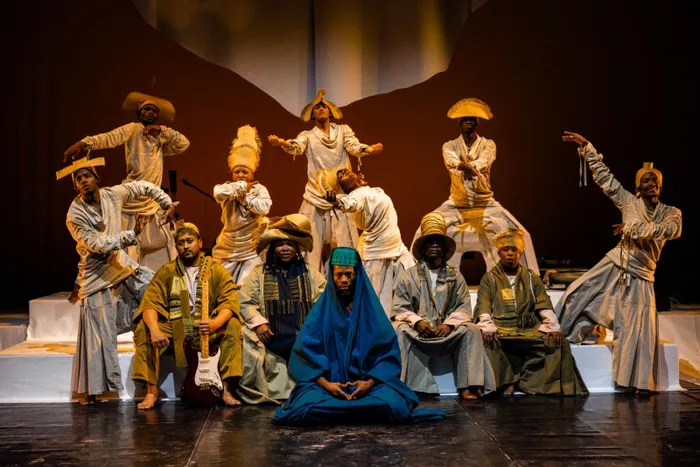
Genesis: The Beginning and End of Time in action. Live music by Mthwakazi Chosi, Annalyzer, Yogin Sulaphin and Xolilisle Bongwana, poetry by Anelisa Phewa, and the libretto brought to life by celebrated writer Karthika Nair.
Image: SUPPLIED
Internationally acclaimed South African dance-maker Gregory Maqoma returns to the Baxter Theatre with the world premiere of his latest work, Genesis: The Beginning and End of Time.
Weaving together movement, live music and poetry, the production speaks to the pulse of a nation in motion. It runs for a strictly limited season from February 18 to 21. Arts enthusiast, Unathi Kondile, caught up with this visionary choreographer whose work has helped redefine contemporary African performance on the world stage.
Unathi Kondile (UK): Welcome back to Cape Town. The last time I saw you was in 2023 when you said you were retiring with the Exit/Exist performances. What did you mean by retiring?
Gregory Vuyani Maqoma (GVM): When I spoke of retiring during Exit/Exist, I was not referring to withdrawing from making work. But stepping away from performing on stage, I was speaking about retiring a certain version of myself, the body that had carried 35 years of performance, the urgency of proving, the hunger of survival. Exit/Exist was a ritual of release. It was about stepping away from being the primary vessel on stage and stepping more fully into authorship, mentorship and composition. Retirement, for me, meant transition from centre stage to the architecture of the stage. It was never about silence. It was about evolution.
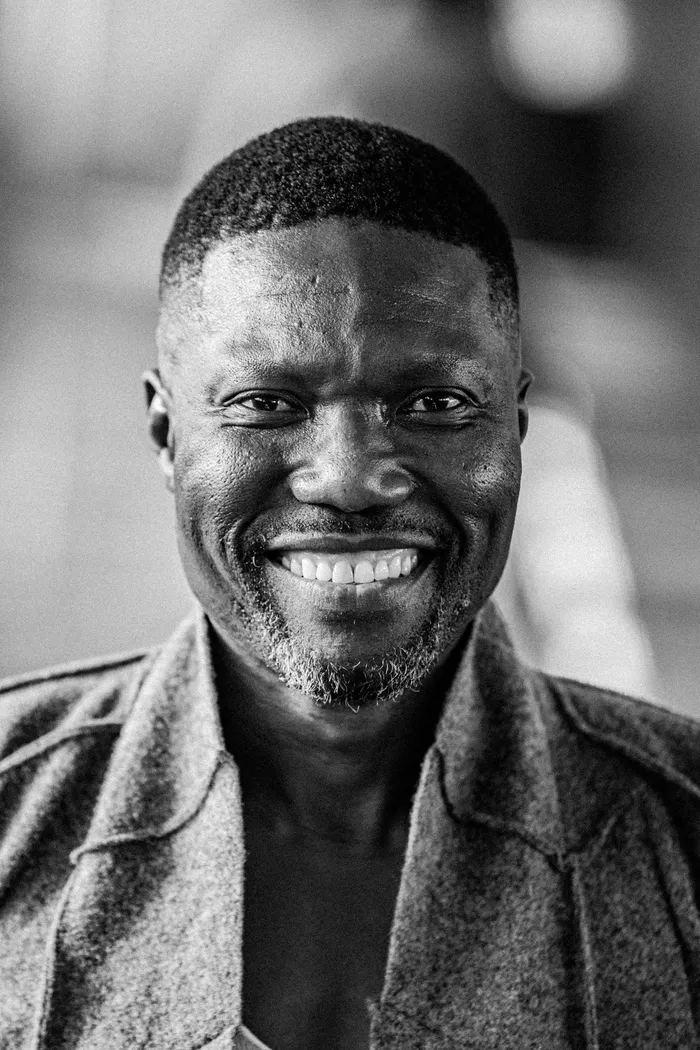
Gregory Maqoma
Image: SUPPLIED
UK: So, will you be performing in Genesis this week at The Baxter or what role do you see yourself playing this time around? Conductor? Director?
GVM: I am not performing in Genesis. This work belongs entirely to the ensemble; the dancers, singers and musicians who embody its tensions and contradictions. My role is that of director and composer of the overall architecture. If I must define it, I would say I am a listener. I am shaping space, time, rhythm and silence. I am guiding the collision between movement, voice, and text but I am not inside the physical score. There is something powerful about stepping back and allowing other bodies to carry the argument.
UK: “Genesis: The Beginning and End of Time” has biblical undertones. Why this title for this week's performances? Are you invoking something by using the Genesis chapter title in a South Africa context in 2026? Uzama ukuthini kuthi (What are you trying to convey)?
GVM: Yes, the title deliberately carries biblical resonance. But I am less interested in religion than in origin stories. Every society tells itself a beginning and those beginnings shape power. Genesis is not declaring itself the beginning. It is inviting us to recognise that the beginning is always available if we are courageous enough to claim it. In a South African context in 2026, we are once again negotiating questions of origin: Who belongs? Who defines morality? Who speaks for the nation? Who controls the narrative of “the beginning”? By invoking Genesis, I am asking: what if we rewrite the beginning? What if we refuse the inherited script? “Uzama ukuthini (what are you trying to say)?” Ndizama ukubuza (I am trying to ask): if time is cyclical, can we choose a different starting point? Can we begin again not from conquest, but from humanity? And to re-read and listen to the revolutionary ideas of Steve Biko, Aime Cesaire, Frantz Fanon to guide as we eradicate what has not worked before.
UK: In the media release we got last week, you mentioned the honour of revisiting The Baxter, you say this theatre has been a partner in your becoming as a dancer and choreographer. Their support has allowed you to confront the violence of time... What is the violence of time you refer to?
GVM: Time erases. Time distorts. Time buries uncomfortable truths. Time allows injustice to normalise itself. In South Africa, we speak of 30 years of democracy but for many, inequality feels inherited rather than interrupted. The violence of time is when history is unresolved, yet we are told to move on. In the choreography, this violence appears as rupture repetition that exhausts the body, gestures that cannot complete themselves, breath that is interrupted. But there is also grace in time. It offers return, reflection, and the possibility of renewal. The work lives between those two forces.
UK: Back to Genesis. This time you fuse dance and opera. But each of these tends to be strong enough to tell its own story alone. What do you feel you achieve by combining opera and dance?
GVM: Opera amplifies emotion. Dance embodies it. When fused, they create a layered dramaturgy where voice and body are in dialogue, sometimes in harmony, sometimes in disagreement. Opera can articulate what the body cannot say. The body can reveal what language hides. By combining them, I stretch scale. The work becomes intimate and epic at the same time. It allows the audience to experience narrative not just intellectually, but viscerally through spiritually heightened vibration, breath, resonance. It is less about hybrids for spectacle and more about necessity. The themes demanded a form that could carry both myth and memory.
UK: How would you like those who are not well-versed in Opera and Theatre/Performance Art to engage with this work? What is the storyline? And how easy will it be for an uninitiated audience to follow the story?
GVM: You do not need to understand opera to feel vibration. You do not need to decode contemporary dance to recognise grief, longing, hope. The storyline is not linear. It follows a cycle: birth, knowledge, fracture, exile, confrontation, and return. There are figures: a shepherd, a tempter, seekers, witnesses but they are archetypes rather than characters. The invitation is not to “understand” everything, but to surrender to experience. For an uninitiated audience, the work remains accessible because it is rooted in human emotion. It asks: Where are we now? What have we inherited? What must we release? These are universal questions.
UK: Thank you so much! I look forward to experiencing 'the Genesis' this week!
The limited season of Genesis premieres at the Baxter Theatre this Wednesday, February 18, at 19:30. The production will have just five performances, including a Saturday matinee at 15:00.
After its world premiere in Cape Town, Genesis transfers to the Joburg Theatre from March 19 to 22.
*This article was first published in the Cape Times on Tuesday, February 17.