

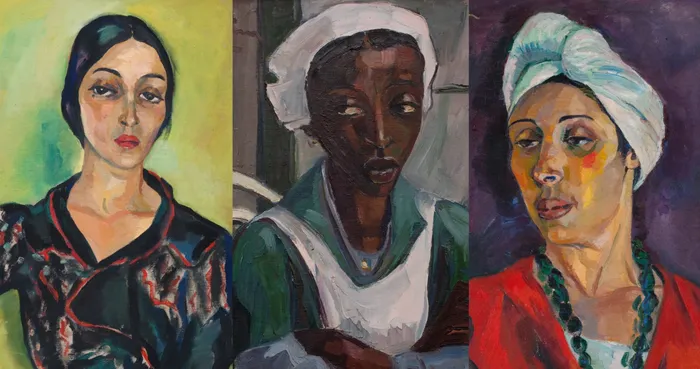
Faces of Cape Town works by Irma Stern at Strauss and Co
Image: Supplied
At the end of October last year, the University of Cape Town and the Irma Stern Trust dropped quite a bomb: The Irma Stern Museum at the Firs, in Rosebank, was shutting its doors.
The announcement was met with “huge consternation”. Art lovers would have none of it. Emergency meetings were convened at Nedbank’s V&A Waterfront offices, galleries were approached and a plan was hatched.
Yet amid all the manoeuvring, one question remained glaringly unanswered: How?
If journalism hadn’t died in 2020 (like I said it did), any journalist worth their salt could’ve easily uncovered that one need not be an Indian to be a Gupta in South Africa.
Here lies the irony of our times: We are drowning in heaps of information, yet we do not know how to swim up and see what’s really happening above the surface.
Everything comes in fleeting flashes. Bombarded by events, news and commissions of inquiries (that ironically feature Norman Arendse too). Zero deep probing. Something happened at the Irma Stern Museum.
In 2022, Strauss & Co pulled off a R22-million fundraiser to restore the Irma Stern Museum. Yet, today, questions linger. After all that money and all that effort, what went wrong? How can we accept that the museum closed “due to critical structural issues and severe dampness and mold that threatens the art collection”?
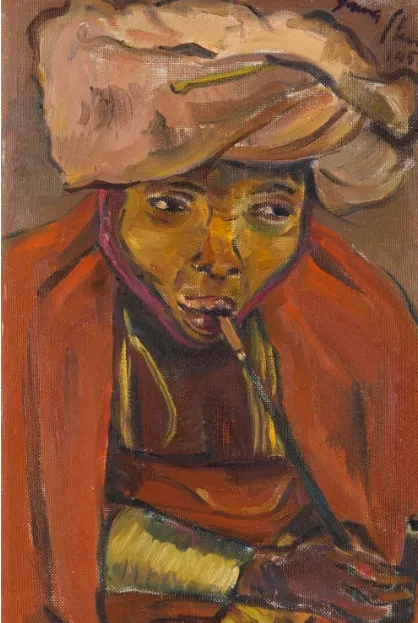
Irma Stern - Pondo women with a pipe.
Image: Supplied
To this end I dialled up a restoration expert friend in Franschhoek. His answer was a blunt: “That is nonsense!”
“A restoration job on a building like that could take up to six months. Ideally it should be done toward the end of summer. Those 1800s buildings are solid. They are baked bricks! Your headache will be the floors and roofing, and sourcing timber. I assume it is likely Oregon timber. Some walls will need stripping and replastering, but overall, you’re looking at just over R7 million to bring a building like that back to life. I’d need more pictures. A few more millions might be needed if you want to modernise the infrastructure too.”
So, pray tell, what the actual **** is going on? Perhaps that’s the only proper way to ask this. Let’s go coarse, because politeness has clearly yielded nothing but silent acceptance.
So now the house is closed. Irma Stern’s works and artefacts are being moved to a “purpose-built” facility at the Clock Tower in the Waterfront. The original museum, meanwhile, will remain closed indefinitely.
The Good News.
A good Samaritan of the arts played matchmaker, bringing the Irma Stern Trust together with the Norval Foundation. This proved to be a fortunate pairing and the relationship is off to a promising start. Their public courtship begins this week with Irma Stern: A Life of Displacement, an exhibition tracing the extraordinary journeys, life and enduring artistic legacy of South Africa’s modernist pioneer.
“We’ve agreed on a two-year partnership with the Irma Stern Trust,” said Caroline Greyling, director of the Norval Foundation, in conversation with Pippa Hudson on CapeTalk earlier this week. “Over the next two years, we will be showcasing works from Stern’s collection through a dedicated programme of four exhibitions exploring her life, travels, archives, and legacy.”
The first instalment of the Irma Stern exhibition at the Norval opens today, running until August 17. It will be followed by three more exhibitions, each exploring different facets of Stern’s life and work. Visitors can expect rarely seen paintings, works on paper, travel artefacts and personal documents from the many landscapes she inhabited.
But wait, there's more.
Strauss & Co in Woodstock is also opening a Stern exhibition - Faces of Cape Town: Portraits by Irma Stern. This one is a capsule exhibition that complements the Norval one and it focuses on Stern’s life in Cape Town. It will be accompanied by a short film, Irma Stern: A Modern Artist Between Cape Town and Berlin, shot during her landmark exhibition at Berlin’s Brücke Museum.
Cape Times