

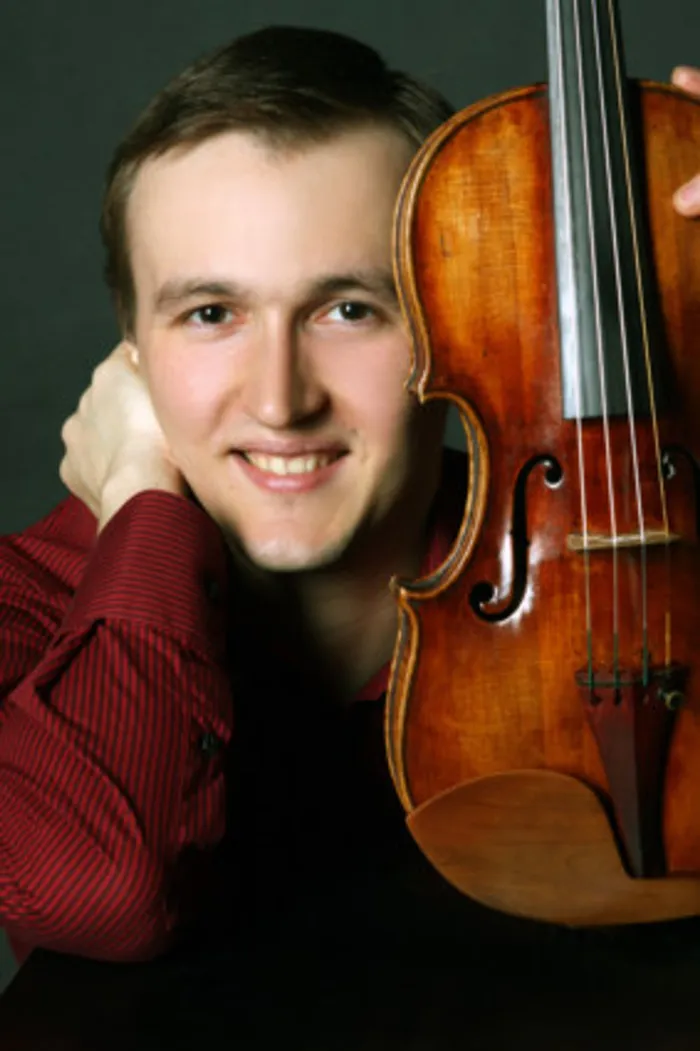
JUST 30 and still “developing as a violinist”, the young Russian superstar Nikita Boriso-Glebsky is refreshingly humble about his road so far travelled. Boriso-Glebsky will play the Concerto no 4 by Vieuxtemps, a work he quotes Berlioz as saying is a symphony for violin and orchestra, with the Cape Town Philharmonic on Thursday at the City Hall.
He is also always learning, he says, and hopes to still be learning when he is old and grey.
Boriso-Glebsky is mad about the concerto. “It is such a pleasure for me when an orchestra listens to my request to play something that is less usual but tremendously good. This concerto is lyrical and melodic, serious music with a full orchestra and written in four movements, one more than usual for a concerto. It was played often in the golden age of violinists like Heifetz and Milstein but became forgotten, quite unjustly.”
He even introduced this Belgian composer to the country’s national orchestra – and the musicians loved it.
This is his first visit to Cape Town, but not his first concert with conductor Conrad van Alphen. “We have played several times together – in Moscow, Rotterdam and Amsterdam – and Conrad brought the CPO and me together.”
Boriso-Glebsky, who studied in Russia, Belgium and Germany at conservatories like the Tchaikovsky, first entered the Sibelius Competition in Finland in 2005.
“I only got through to the second round, but while I was really disappointed I felt so much at home with the warm and positive Finnish audience and the huge programme that I built up the courage required to enter the next one five years later.”
He won that competition, and was soon on his way – a London-based management company “IMG Artists” took him onto their roster and soon he was getting engagements and meeting important musicians, particularly at festivals.
“The days are over when winning a competition sets you up for life,” he says. “They certainly help.”
He should know – he has won outright or at least major prizes in 11, from the Sibelius to the Kreisler, Montreal, the Queen Elisabeth and the Monte Carlo competitions. Then he gave them up.
“Competitions certainly help with development – from learning how to deal with a performance on a stage in front of a live audience and most importantly to deal with the pressure and how to cope with a big and difficult programme. They certainly help you to go from concerto to concert, and although going out on stage is never easy this seems to make it a little less traumatic.”
On the other hand, he says, competitions don’t help with musical development like artistry and technique.
“One sometimes has very different perceptions of one’s own playing After I won the prize at the Queen Elisabeth, I felt in very good shape and had a great programme and went on to the competition in Munich. I didn’t get beyond the second round! Other times I think I have not played so well and everyone raves about it! So preparation is something you learn from competitions as well.”
He divides his time between homes (with his wife, the flautist Irina Stachinskaya ) in Moscow and in Brussels, an apartment he kept after studying at the Queen Elisabeth Chapel of Music, seeing the need to have a base in Europe where he spends much of his time playing. He gives something like 60 concerts a year, some with orchestra and some in chamber music festivals like the one in Giverny in France, where he has been going for the last five years in late August. Last year he and Irina played together, and will again this year, most specifically a piece for violin and flute, Stamboul, written by a composer friend Kuzma Bodrov. “That’s a lovely gesture and something we are very proud of,” he says.
This year, along with Giverny, he will play quintets and quartets with great musicians in two festivals in Austria, one run by his friend the violinist Valeriy Sokolov.
He has collaborated in chamber music with some of the best – Natalia Gutman, Gidon Kremer, Yuri Bashmet, Andras Schiff, Boris Berezovsky and Alexander Kniazev, for instance.
The day before leaving for Cape Town he plays in a chamber music festival in Yaroslavl close to Moscow, and then after his concert in Cape Town returns to Brussels where he and five friends in the Rubik Ensemble will play before the European Parliament.
“We would love to play often together but we are all busy musicians from six countries and we only manage to get together a couple of times a year.”
Boriso-Glebsky has been widely praised for the depth of his musical thinking, impeccable technique and a rare combination of elegance, naturalness and uncompromising severity of performance, and now performs with many of the world’s foremost orchestras under conductors such as Valery Gergiev.
He has been an exclusive soloist of Moscow Philharmonic Society since 2007.
His CDs include two in collaboration with the Queen Elisabeth Music Chapel and the Belgian label Fuga Libera: the Third Violin Concerto of Henri Vieuxtemsp with Liege Royal Philharmonic and Patrick Davin, and the monographic album of Edouard Lalo with Sinfonia Varsovia, Augustin Dumay and Jean-Philippe Collard. The latter CD was awarded five stars by the French magazine, Diapason.
You can hear him perform on a Matteo Gofriller Violin dating back to 1720-30s. Also on the programme are the Prague Symphony by Mozart and the Symphony no 7 by Dvorák.
l Tickets: Computicket 0861 915 8000, or Artscape Dial-A-Seat 021 421 7695 Concert information: 021 410 9809, luvuyo@cpo.org.za